Followers

Showing posts with label time. Show all posts

Friday, 19 May 2017

Old Joe's Old Chair: time past, time present

Over 40 years ago we lived in Suffolk. In a village 25 minutes' drive away lived Old Joe and his sister Rose. Joe was an osier, that is, he made baskets out of willow canes. ("Osier" just means "willow," of a certain sort.) Beautiful baskets, light, strong, in subtle natural colours. 

He showed us how he soaked them (horrible cold dirty-looking water in a big tin bath arrangement) to make them flexible. He had strong hands that worked quickly and firmly, but showed the wear and tear of his trade. His outdoor workspace was - rough and ready, to put it gently.

Joe and Rose lived in what at a safe distance looked like a picturesque thatched cottage. It was...not in good nick. Inside, it was a bit of a jumble, but no doubt it was how they liked it. It could have been called "a bit of a slum" by an outsider driving past.
 This sort of thing - but this isn't Joe's place.

Perhaps it's now a second home, cleaned out, done up to the nines, owned by someone wealthy.

It looked as though they lived on very little - certainly, his baskets were good value given the hours he put into them. They had a sturdy, hand-made look to them, not like the uniform, smooth mass-produced and mostly imported baskets that I would guess put Joe out of business a long time ago.

Joe had a little high voice and a very strong Suffolk accent. He wore a grubby old fawn mac tied up with string. We told him the name of the village where we lived. "I bin there once!" he squeaked. "Man on the beach there selling...oranges and...apples..." 

For a moment, it sounded as exotic as it must have looked to Joe, all of nine miles away from his cottage.

Joe and Rose seemed uncompromisingly "authentic." They weren't part of any heritage industry. I never saw any kind of advertising - you went there because someone told you about it. They seemed living relics from an ancient rural past.

Joe agreed to make us a willow-cane chair; a new task to him, but he reckoned if he made an oddly-shaped basket, turned it over and fitted a back and sides, it would work. He gave it thought, and a lot of care.

It worked. It was very light, and it creaked delightfully every time you moved in it. It seemed like an artefact from a different century (we weren't especially keen on aspects of our century back then.) It was wide enough to sit in with a guitar. It was entirely unique. Old Joe's chair.
Joe's chair, I found recently, was full of woodworm, and the rats had got at it. It had to go.

It made me sad, and yet I had hardly used it for years - decades. It wasn't really all that comfortable, though lovely to look at. 

But it was so much of its time, that time in our lives. A new baby, new friends who are now now old friends, folk music, Barsham Fair, Sandy Denny solo at the Ipswich Corn Exchange - I've an additional big nostalgic name checklist I'm not going to drop on you.

Rose died soon after we left Suffolk, and since she kept Joe going, ran the house and so on, I don't like to think how his final years might have been. 

Nothing is constant in this universe, except change. We're all nomads. Old Joe's gone, and now so has his chair, a link between our garden now and our garden then, our lives now and our lives then.

Trying to hold on to the past just makes it hurt more. I have to allow my nostalgic sadness, not try to squash it. I have to be with those feelings, in the present. 

And I have to take the chair to the tip.   

But I won't forget Joe and Rose.


Thursday, 17 November 2016

Time Doesn't Exist

What a daft statement. NASA can aim space vehicles with millisecond accuracy to meet up with each other millions of miles from Houston. You can buy a watch for £40 that cordinates with sattelites and crystal vibrations and, er, stuff (?) and is accurate to a millisecond. 

But: an airline pilot writes that from 40,000 feet up you can watch the sun's shadow creeping across the planet, and you realise time zones, sunrise etc are a matter of geography, a matter of positioning in the universe - positioning which changes all the time. Our sense of time and how we measure it is a product of change in the positioning of stars and planets, of electrons and protons etc. It's entirely relative. (Look, I know this is all blindingly obvious to science brains, but I'm quite new to this stuff, so cut me some slack, genius!)

We know that time's arrow moves only forwards. We know that we are time-constrained, like all organisms. Like all matter. Our consciousness can only be time-structured; we cannot really deal with eternity, understand it in any conceptual sense. Did you, as a kid, look at the sky, or the bedroom ceiling, and think or say "for ever" over and over again, until you had to stop it because it still didn't fit with anything you knew? (Yes, ok, I still do it sometimes..)

Do you now think, as I do, that we are all change, only change, from moment to moment, and that's only very crudely measurable by statements about time? 

"I used to think that..." "I used to like the taste of..." But it would not be possible to say exactly when such a change happened, or when it began to happen and finished happening.

Allow me to wheel out Thomas Stearns once again:

Time past and time future
What might have been and what has been
Point to one end, which is always present.


 I think neuroscience can demonstrate that memory is a matter of re-establishing neural pathways as we remember; that we remake the past in the present each time we remember something. Memory is not, to state the obvious again, a file we open with the same memory in it unchanged, every time we want to revisit the past.

In other words, if we "falsify" (change, re-interpret) the past it's because a memory can only be a present event. And obviously enough, the future can only be imagined, planned for, in the present. 

Those plans, those "if I do this tomorrow, then..." scripts we run, may affect, or bring about, what happens in the future. "I'll catch the 09:20 train tomorrow" and lo! It turns out I do catch it. But a plan isn't an event - the train may be cancelled, I may change my mind.

So the past and the future only exist in the present. But the present immediately becomes the past. A thought is past the moment it occurs. So: time exists, past and future only exist, in the present, yet the present vanishes the second (half second? 0.0006 of a second??) it occurs. 

Meditators aim to be in the present, to bring their minds back to the present. (I guess it's similar for those who pray. Or Quakers who don't so much pray in verbal formulations, but sit in silence with the Spirit. Never mind for now what Spirit.)

So mediators are aiming, without striving of course! - to be in the present moment. Which doesn't exist. It doesn't exist as a measurable state. It's a state of being, not a measurable unit. It's transcendent, except that's a verbal category, too, and there is really nothing to transcend.

Time to bang my head against a paradox, and see if that's useful: meditating can take me to a state of being entirely in the present. But the present doesn't exist. 

So what is it that is between past and future, in a universe of constant change?

Nothing. Welcome to the void. To the present beyond words. 

"If all time is eternally present
  All time is unredeemable."

    
"A mind free of thought,
    merged within itself 
    beholds the essence of Tao ("the Way")
A mind filled with thought,
   identified with its own perceptions,
   beholds the mere forms of the world."

But such wordless perceptions, such states of being, can be scary, because they show us that the self - our selves, me dammit, is not the separate and coherent thing we think it is. We are flux. Everything flows, constantly. Stillness is either a relative position, or an illusion. 

And, TS again, "human kind cannot bear very much reality."

Nevertheless, maybe, just maybe, the world around us would be a better place if more of us spent more time in that ego-dissolving, non-timemeasurable, wordless state of being.

"Tao and this world seem different
    but they are one and the same
The only difference is in what we call them."

because "A name that can be named is not The Name."

So a little more of The Name would help us in this world of ordinary names.

I don't know about you, but my head is beginning to ache. Time for lunch.


Monday, 18 July 2016

Conran, time, jasper

I didn't want to suggest, in my last posting, that Tony Conran's poems were always difficult to fathom. Look at the imaginative power and directness of this - he was so good at poems for people he knew, for friends - he had a gift for friendship, and it fuelled his powerful imagnination.

Jasper for John Jones the potter
 
Waxwork of a crag, a model of sea rock
In gleaming maroon –
Hear the waves break on it, see the fish fly
Under the moon!

A piece of witch-stone, jasper,
Red chalcedony
With a tidewash of grey quartz still ebbing
Back like the sea.

 I was given it, it has lain in my hearth
Nearly a year
To give peace by arbitrary charm
To fingerers here.

Each hand that stroked it, gave to and took
Power out of it:
Love warmed it with whitsun, it knew
Fire-tonguing wit.

It felt stillness in half-light, it learned
Like a wild foal
To stand calm in a crowdful of noise
In its deep quartz soul.

It is Welsh rock, John. A vein of it runs
In the nape
Of the hanging coast where the oaktrees
Knot the Straits into shape.

Earth, water and fire! and a girl’s hand that gave it
Dearer to me
Than gold! – I send you this shard from the wheel
Of the Welsh sea.

Your potter’s eyes found glazes in red grit –
You made them yours,
The piebald debris of metallic earths,
Ragbag of ores.

We finger a pebble for luck, or chance
Magic try –
But your fingers have lived with luck so long
They must have it, or die.

And your hands chance no amateur magic:
The wheel must turn,
The wet grey clay must rise like a genie
To teapot or urn.

Yet now, because you have left Wales, and sold
Kiln and wheel
And because your cottage sinks down to its knees
In an overgrown field,

And the racks in your front room shop
No longer fill
Quietly, quietly with the cups and jugs
Of your fingers’ skill

And because now, though the potter’s gone
And the clay dries dead,
We are glad that the love of a bride
Has graced your bed –

That ancient, amateur magic of hands,
A love and a luck
Richer than even from clay
Ever was struck –

Because of all this, on your wedding day
I send
All the power in a stone I can
To make and mend:

A piece of witch-stone, jasper,
Red chalcedony
With a tidewash of grey quartz still ebbing
Back to the sea.


And now I'm feeling hiraeth for John and his work, and for the time I knew him a little; I have a jug or two of his. His cotttage sunk down to its knees in an overgrown field....

We humans are in love with the products of time. Unlike chalcedony, which simply is a product of time and has - no purpose...


Friday, 27 May 2016

pier end

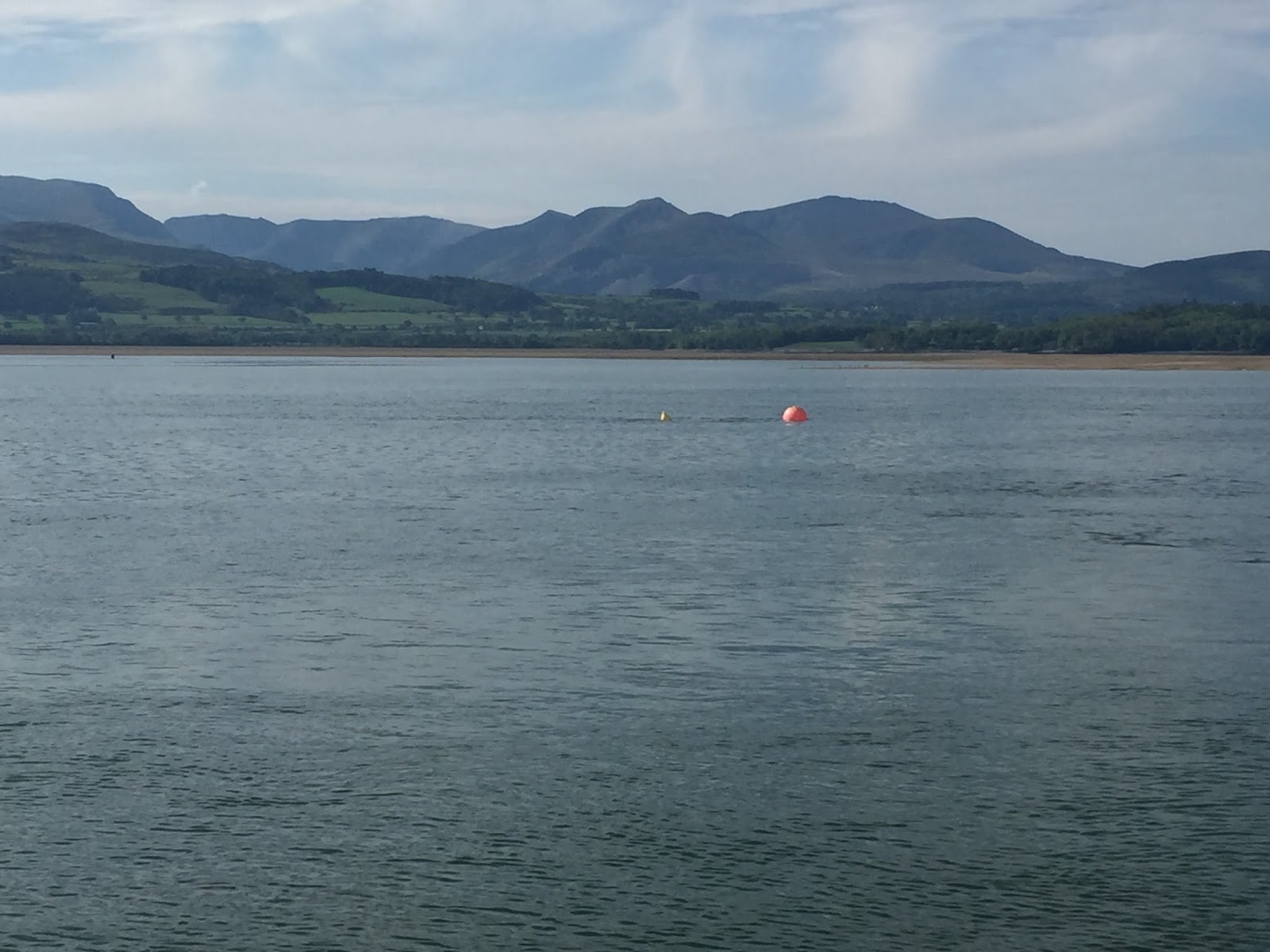
On our little pier this morning, they'd left the gate open to the ramp that goes down to the jetty. It's usually locked. I was the only person on the pier. Down I went for a new view of the pier itself.


It was a calm, sunlit, very clear morning, the sort of morning that sometimes gets called "magical." I can see why, but it's not magic, it's greater than that - a chance to feel the complete nowness of it all. Clarity in the world around, clarity inside the mind. No need for exaggerations, or even for adjectives and superlatives. Though it must be said, it was a pretty superlative day!

 I was alerted to it all by a heron coming in to land back at the water's edge - the slow, determined wingbeats low over the water, the little turn and uplift, then a drop onto long legs. I watched him closely, until the heron, the morning (water, hills, sea-smells, buildings, distant workaday noises) and this organism writing to you now felt - identical. The same thing/s.

I grabbed the chance to get close to the water - not the edge of the waves for once, instead I was close to the flowing, ever-changing ripples and swirls.
 All matter changes, flows - the tide, me, even the distant mountains - and all matter is also now.

"Time present and time past
Are both perhaps present in time future,
And time future contained in time past.
If all time is eternally present, all time is unredeemable."

Or - you can't put your foot in the same tideflow twice.

A memory is a present event, the future is a present event, in my mind. The present is the only place I am, and yet it is instantly gone, as soon as it arrives. So where am I?

I am on the end of the pier, in the now, with the heron. That's all I can say, and it won't really do. You can't describe the non-verbal state of mind through words, because it's a state of being. You can teeter round the edge of it with words, but that's trying and of necessity failing to describe a Zen state, it isn't being in it.

Back to the water, then.


I turned and walked up the ramp. I'd been alone on the pier, but now a steadily increasing number of people were walking about. Contrary to my feelings of defensive privacy and anxiety about rubbish and noise in a previous post (the Secret Valley walk), I found myself pleased to see these people wandering around in the slightly aimless and relaxed way you should wander when you're on holiday. I found myself feeling thus, I wasn't trying to be nice. They were welcome by the water, and I hope it spoke to them. I find it usually does.


Tuesday, 3 May 2016

what the heartwood said

This is heartwood, from a big log I split today. We were sad to lose a grand old oak that had been leaning at 45 degrees for many a year, till the storms of January/February took it down to 20 degrees, and made it dangerous (or so my neighbour said) so it had to be cut back to the fence line. 

It smells wonderful - rich, damp and complex. The patterns in the wood are beautiful - irregular yet coherent, a living thing. Hard to believe that something so tough is the product of a plant.

"Hearts of oak are our ships, jolly tars are our men" - from "Rule. Brittania," not such a popular song these days, but something sung in school when I was small. That salutes oak as a valuable raw material to build the ships that did indeed rule the waves,centuries back.

When it's seasoned and dried, it will burn well in our log stove - another very different use of the heartwood as a raw material.

But there's something else to consider, other than its usefulness to Nelson's navy and our stove.

It's a time machine, like any grown thing; it carries its unique history in its structure. It has a story to tell us that we can't really read in any detail. Stifling summers, bitter frosts, raging storms, calm autumn mornings, all grown into its structure and recorded in its patterns and shapes.

 
When is such wood dead? It looks, in its heartwood, as it did when the tree stood tall, I'm sure.  But it can grow no more, so I guess it is very slowly changing its state. No more feeding, no more growing,  just a slow drying out, and then, if it had been without human intereference, a wetting, a slow rot, host to countless organisms. 

But as it is now, a log to throw out some heat, and then ash. 

So let's sniff at it again, pause and look at its beautiful roughness, acknowledge its hardness and strength (it's a bugger to split, I can tell you that.) Let its past stand up and be counted in its present state. No need to rush it into the stove; it's been centuries growing, and although its time-scale is very different from mine,  for the last ten years its shared the same wind, sunshine and rain as me. Copmpanions, of a sort. A tutor to me, for sure.


Monday, 25 January 2016

I'm not what I thought I was: Eagleman's Brain, TS Eliot, and me


David Eagleman on the brain, BBC 4 TV. 

Remarkable (to me, at least) stuff about the way the brain perceives the world around it. If this interests you, please bear with it; it's a bit lengthy, but I'm going to try to relate it to thoughts about the self, and about the present moment.


Sprinters need 1/10th of a second for their brains to process the sound of the start gun. This can't be improved on, however much you train. You can become faster at getting off the blocks, but you will always be 1/10th behind the actual sound of the gun when you start moving. And if you use a visual signal, say, a light coming on, the gap is longer, because visual processing takes longer, is more complex.

So the brain needs time to make anything happen in the body, and it "hides" this delay, it doen't show its workings. We think our response is simultaneous. It isn't. So in a sense, we are living in the immediate past. We can't perceive the immediate present moment - it's gone before we can process it, so we act retrospectively. 

I think somehow, we maybe know this, or sense it, which is perhaps why the present seems so intangible compared with the past- memories, and the future - plans, hopes and fears.

I'll move on to sight. The eye takes in signals and sends them to the brain, and that is where we actually see things. Signals go to a bit of the brain called the thalamus for processing before going to the visual cortex, where vision takes place. But signals go back and forth between eye and thalamus, as the brain takes in visual signals, compares it with what it's already got, issues instructions to the eye (something like"look top left corner, tell me...") and then when it's done (lightning speed, of course) it sends the final version up to the visual cortex, which is when we see what's before us. 

But we never take in with the eye exactly what is in front of us, all of it, because the brain works on a "need to know" basis. 

This is quite easily tested; try looking at a picture with a narrative or descriptive title, which will arouse expectations. Constable's "The Hay Wain," for example. Look away, and then have someone ask you what the picture's about, and you'll probably say "a hay cart in the middle of a river." Then get the second observer to ask you something irrelevant to the title, such as "how many chimneys does the cottage on the left have?" You probably won't know, unless you know the painting very well already. 

This isn't, or isn't only, about the memory, it's about how we see. If you were asked first off about the chimneys you'd get it right, because that's what you'd look for - but you mightn't know how many horses were pulling the cart. So you're using your eyes as collectors of sensory data, on a need-to-know basis, and adding and amending the sensory data accordingly. We are seeing with our eyes what the brain, to some degree, is telling us to see.

What this means is that our vision is always partial, always selective. And so my visual idea of the world around me will be different from someone else's, because they will have been looking for and logging different things. This data adjustment happens all the time, constantly, and very fast. 

But it still leaves us with a profound truth: our perception of reality is transient, dynamic and unique to each of us. As Eagleman puts it, the brain is the universe's great storyteller, creating realities inside our heads, and my brain provides its own unique model of the universe around us. 

Reality is what your brain tells you it is, and it is not constant nor held entirely in common with others. (Happily there are overlaps between our realities, or societies would collapse!) 

There was a lot more to this fascinating programme, and it was only the first part of a series, but it supports some ancient insights: our sense of reality is partial, and it changes. It isn't fixed, not for you or me, however much it feels like it. And - the present is over before we know it, yet the present is the only place we can be. Memories happen in the present. Hopes for the future happen - in the present.

 " Time present and time past
Are both perhaps present in time future
And time future contained in time past.
If all time is eternally present
All time is unredeemable.
What might have been is an abstraction
Remaining a perpetual possibility
Only in a world of speculation.
What might have been and what has been
Point to one end, which is always present."


The paradoxes of the present moment, if taken right in, can free us from illusions of permanence, can help us live not just with, but as, change.

"Words move, music moves
Only in time; but that which is only living
Can only die. Words, after speech, reach
Into the silence. Only by the form, the pattern,
Can words or music reach
The stillness, as a Chinese jar still
Moves perpetually in its stillness.
Not the stillness of the violin, while the note lasts,
Not that only, but the co-existence,
Or say that the end precedes the beginning,
And the end and the beginning were always there
Before the beginning and after the end.
And all is always now."


I think at this point I'll stop quoting from "The Four Quartets," with just a reminder:  

"Fare forward, you who think that you are voyaging;
You are not those who saw the harbour
Receding, or those who will disembark."


To wake up to reality, we need to live with the understanding that reality is provisional, partial, ever-changing; and we are part of that ever-changing reality. Given this as demonstrably true, how can the self, yours and mine, be anything but a changing construct? 

Back in the world of neuroscience, Eagleman looks out over a city and says "where abouts is the economy of this city?" No place. It is a huge set of interactions, of relationships, always changing. Where is my self? There is no place in the brain where you can find it. It's a lightning-fast collection of mental interactions, within me and between me and the outside world. I am change. I am processes, not a thing.

The illusion of a permanent self might be socially useful. The illusion of a fixed reality out there in front of us, ditto. Just so long as we don't mistake it for ultimate reality, not knowable by the reaasoning intellect.

"Not farewell, but fare forward, voyagers." Into the paradoxes.

Thursday, 26 March 2015

Eliot in Terminal 3

"Fare forward, travellers, not escaping from the past
Into different lives, or into any future;
You are not the same people who left that station
Or who will arrive at any terminus, 
While the narrowing rails slide together behind you"

or as you make your way to the boarding gate through the time-zone hammered crowd in the transfer terminal....

I wonder what Thomas Stearns would have made of terminal 3 Changi Airport, and the subsequent voluntary reimprisonment in a huge aluminium tube as the planet turns beneath you whilst you doze fitfully an impossible six miles above the ground.

Same difference, I guess. We are not the same people as those who left LHR, or who will arrive at wherever we're going. However desirable the travel may seem, for whatever good reason it's undertaken, it's not an answer, or a question. We can't create the future by hurtling towards it at 600 miles per hour.

"Not fare well,
But fare forward, voyagers."